A buyer runs a weekend campaign across nine stores. By Monday, the report shows six stores sold at the planned price, two sold at last month’s price, and one applied the discount twice.
Nobody did anything careless. The deal was built in two places, one store still had an old override on the item, and another had a loyalty bonus stacking on top of a bundle.
A cloud POS is a point of sale system where pricing rules, promotion settings, sales data, and reporting sit in cloud-based software instead of living separately at each store. For a multi-store retailer, the value is not just checkout from anywhere. It is giving head office one place to control the rules every till follows.
Why Price and Promotion Control Breaks Across Stores
Pricing rarely goes wrong through one bad decision. It drifts, through small reasonable choices made in different places, with nothing pulling them back together afterwards. Five patterns account for most of it.
- Price updates applied store by store, which leaves the last few locations running behind.
- Promotions activated manually, which means someone has to remember the start time.
- Expired campaigns left running because taking them down is nobody’s named job.
- Discount rules configured differently in the store system and the webshop.
- Local overrides with no end date attached to them.
Overrides That Outlive Their Reason
A manager marks down damaged stock or matches a competitor down the road. The decision is sound on the day. Without an expiry, the item keeps selling at that price long after the reason has gone, and the price file in head office stops describing what customers actually pay. Multiply that across a network and the gap becomes material rather than annoying.
Rules Built Twice, Slightly Differently
When a promotion is configured separately for stores and for the webshop, the two versions drift on start time, qualifying products, or how the discount interacts with a loyalty tier. Customers notice before finance does.
The NRF makes a useful point in its piece on algorithmic pricing, which is that retailers have long adjusted prices to demand and cost. What changed is the speed, and speed is unforgiving when the setup is duplicated.
Reporting That Arrives After the Campaign
Slow reporting compounds all of this. If campaign performance by store is only visible the following week, a rule that captured the wrong products runs its full course before anyone sees it.
Retailers reading about the shifts CIOs can’t ignore in deployment choices tend to conclude that this lag is structural rather than a process failing. Weekly reporting cycles were reasonable when campaigns ran for a month. They are less useful when a weekend promotion is the unit of planning.
What Head Office Should Control From One Place
Central control does not mean head office micromanaging every shelf edge. It means one authoritative set of rules, with clear permissions around who can vary them and by how much. The list of what belongs at the center is shorter than most teams expect, and getting these three groups right removes the majority of the drift described above.
Price Lists and Store Groups
A flagship, an outlet, and a franchise location may all need different pricing. Those differences belong in price lists linked to a store or a store group, not in manual edits at the counter. Grouping matters because most changes apply to a segment rather than to everything. Adding a tenth store then means assigning it to a group instead of rebuilding a configuration.
Promotion Schedules, Bundles, and Coupons
Campaigns should carry their own start and end dates so they switch themselves on and off. Bundles, quantity breaks, coupon codes, and location-specific offers all belong in the same rule set, because they interact.
A promotion that is generous on its own can become unprofitable once a coupon lands on top of it, and that combination is easier to model in advance than to explain afterwards.
Approvals and Change Records
Someone should approve a rule before it reaches customers, and the record of that approval should survive. Head office also needs to see what a rule will do before it goes live, meaning which products it captures, which stores it applies to, and what it does to margin at item level.
Where finance and accounting systems sit on the same data, that margin view reflects landed cost rather than list cost.
| Approach | Where prices are set | What happens when a rule changes | Where the risk sits |
|---|---|---|---|
| Store by store setup | At each till or back office | Repeated manually in every location | Missed stores and stale overrides |
| Channel by channel setup | Separate tools per channel | Duplicated, then drifts apart | Different prices for the same item |
| Spreadsheet distribution | Central file, local entry | Emailed out and keyed in | Typing errors and timing gaps |
| Central rules on one platform | Head office, applied everywhere | Published once, live on schedule | Needs clear override permissions |
Why Store Teams Still Need a Simple Checkout
Central control only works if it makes the counter easier rather than harder. Tight rules that push extra steps onto cashiers get worked around within a fortnight, and the workaround becomes the new process. The rule engine belongs at head office. The experience at the till should be almost boring, which is a compliment in retail.
The Right Price Should Apply by Itself
A cashier should not need to remember which campaign is running or which items qualify. The correct price, discount, and loyalty benefit should resolve automatically when the item scans.
When several deals overlap, a conflict resolution engine decides which combination applies, so the outcome is deliberate rather than whatever the till calculates first. That protects margin and it protects the cashier, who is not making a judgment call with a queue building.
Returns, Tenders, and Manager Approvals
Store execution is more than selling. Returns need reason codes so the pattern can be read later. Multi-tender and split payments have to work without slowing the lane. Manager approvals should be quick to request and fully logged, ideally without the manager walking to the till.
Gift cards and store credit need balance checks that resolve in seconds. Retailers working on how to win customers across every channel find consistency at this level is what customers actually notice, long before they notice anything about the platform behind it.
Behavior When the Connection Drops
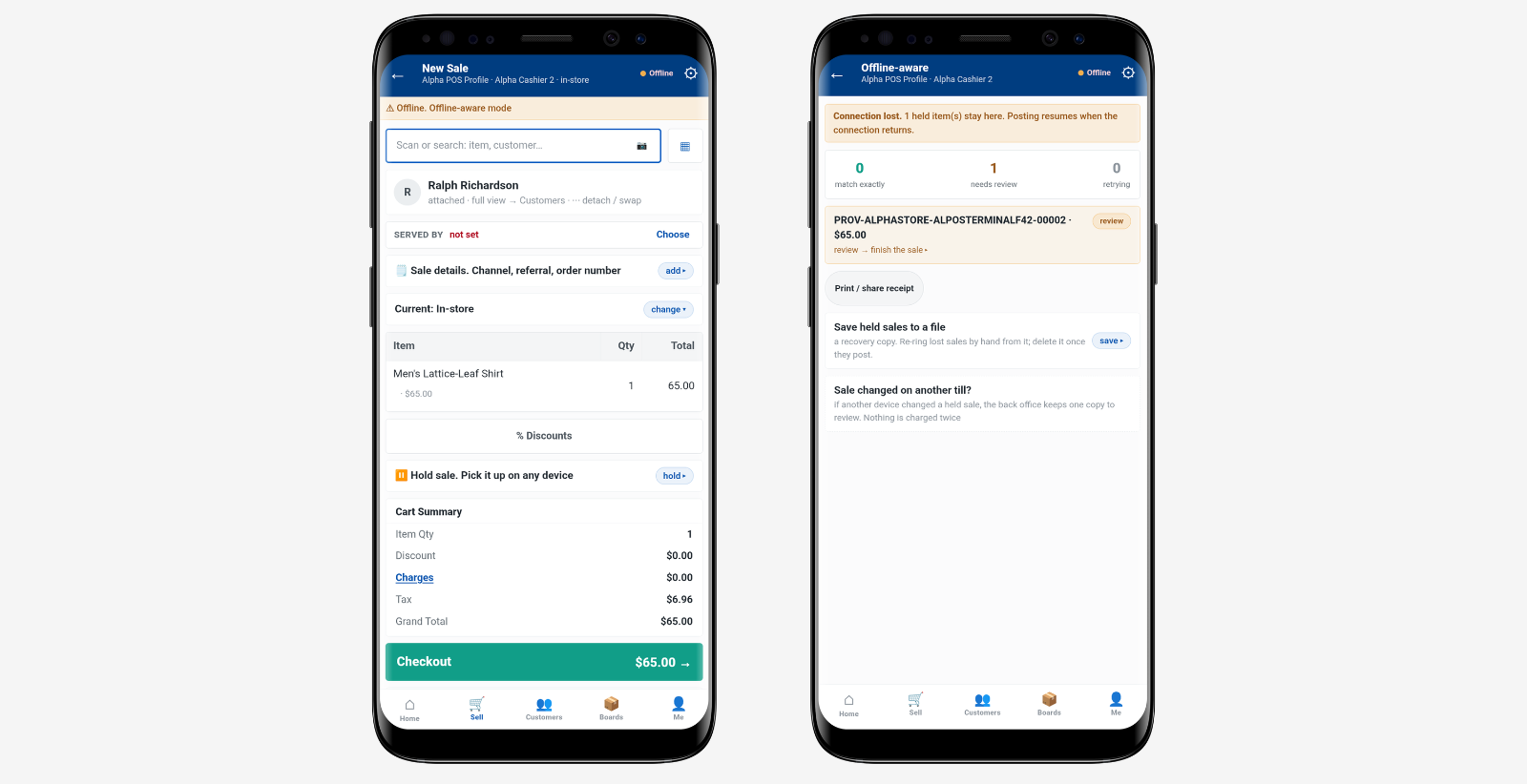
Pricing rules should keep applying if the internet goes down mid trade. Offline resilience means promotions, loyalty accrual, and split tenders continue, then sync once the link returns.
This matters most in the places hardest to fix, such as older sites and busy shopping centers on shared connections. A store with a weak link should not quietly become a store with its own pricing.
What Happens When Promotions Are Not Controlled Centrally

The cost of loose control is rarely one dramatic error that someone escalates. It arrives as a set of small, recurring frictions, each one absorbed by a different team and none of them owned outright. That is what makes the total hard to see until someone adds it up at the end of a quarter.
Margin Leakage and Manual Refunds
Discounts applied twice, or applied to items outside the intended scope, come straight off margin on every basket until someone notices. The corrections cost more than the original error.
A manual refund at the counter takes staff time and creates a second transaction to reconcile. It also tends to happen without a reason code attached, so the root cause stays invisible to whoever reviews the campaign afterwards.
Store Confusion and Customer Complaints
When staff are unsure which price is right, they either guess or call head office. Both are slow, and both happen in front of a waiting customer.
Shoppers who see one price online and another in store rarely raise it politely, and the associate absorbing that conversation had no part in causing it. Retailers who move to cloud-based retail systems often say pricing confidence at the counter is an unexpected early win.
Finance Mismatch and Weak Campaign Reporting
Discounts recorded outside the main system show up as unexplained variance during close, and tracing them back to a campaign takes longer than the discount was worth. Campaign reporting suffers for the same reason.
Comparing planned margin with realized margin depends on the discount having posted against the original sale, so when it did not, the review turns into an estimate. Decisions about next quarter then rest on that estimate.
What to Check in a Cloud POS Before Rollout
Demonstrations happen in ideal conditions. One store, clean data, one promotion, nobody queuing. Trading does not work that way, and the gap between the two is where rollouts usually run into trouble. A short list of questions tends to separate the systems that hold up from the ones that were only ever tested on the happy path.
Rules, Overrides, and Conflicts
Confirm that price updates publish centrally on a schedule rather than store by store. Check that role based overrides carry a defined limit, a reason code, and an approval path above that limit.
Ask specifically how the system resolves two or three overlapping promotions on one basket, and insist on seeing it rather than hearing about it. Bring your own awkward example, since the vendor’s demonstration basket will have been chosen to behave well.
Settlement, Audit Trail, and Reporting
Discounts affect settlement, so ask how promotional value flows into tender reconciliation and into the ledger. The audit trail should show who changed a rule, when, and what it replaced. For reporting, three signals matter most once a campaign closes.
- Sell-through against forecast by store and channel, so allocation can be adjusted next time.
- Realized margin after discount and landed cost, rather than planned margin.
- Override frequency by location, which often points at a stock, pricing, or training issue.
Automated Checks on Pricing Behavior
Pricing errors look ordinary in isolation, which is why people miss them. A rule capturing more products than intended, or a store whose average discount jumps a few points, is easier for a system to spot than for a person reading reports.
With AI and workflow automation reading the same transaction data as the till, those alerts arrive while a campaign is still running. The NRF has also written about the myths around algorithmic pricing. The practical lesson is that automated pricing is only as sound as the cost and demand data behind it.
Pricing That Holds Up on the Shop Floor
Where pricing lives matters more than any single feature. In a connected retail setup, pricing rules, promotions, discounts, permissions, returns, tenders, and settlement run against the same records as stock and finance. iVendNext is one example of this kind of unified commerce model, but the useful question is whether the system keeps those records together in daily trade.
Intel’s overview of retail technology solutions describes the same direction of travel, with store systems moving closer to shared, real time data instead of operating as islands.
Rolling It Out Without Disrupting Trade
Most retailers start with the price file and the promotion calendar, then add permissions and reporting once stores trust the rules. Teams comparing options often use a retail POS system buying checklist to keep the evaluation grounded in daily operations.
Those looking further ahead read around smarter operations, better experiences before deciding what to automate. The practical case is simple: margin should land close to where it was planned, and the numbers should show any drift while there is still time to fix it.